Lost Languages Project

I am asking for people to translate the following sentence into their own language and send it to
saved@lostlanguages.net, with the name of the language in the subject line. The sentence is:

“I am saving my language.”

Predictions by linguists estimate that as many as 90% of the world’s total languages will be threatened with extinction in the next century.
The idea is to produce a statement about how sad it would be to lose the many endangered languages in the world.

If you or anybody you know speaks another first language, particularly people who speak languages with a small number of speakers, it would be great if you could participate and forward this mail asking them to contribute too.

The project will be eventually be displayed at http://www.lostlanguages.net

An Idea…

Language is always integral to the national cultural identity of a people. In Lithuania this must be a particulalry strong identity because it has remained so pure and unchanged compared to other languages that have been born, developed and evolved in the same time. I wonder if the refusal to give up or allow change in their language in troubled times reveals something about the typical Lithuanian personality. Some sort of stubbornness? A nostalgia? Timelessness?

My first idea for piece would invlove interviewing some citizens or going to the country to talk to the Lithuanian farmer sited by the french linguist Antoine Meillet in the text below, and ask them how they feel about their language, why it has been so important to them to retain it and preserve it exactly as it has always been. Then I’d like to write a short piece expressing these sentiments and have it read out in all the different Lithuanian dialects. I would then edit it together so that the dialects run into each other, going from region to neighbouring region consecutively. I’d have subtitles in Standard Lithuanian and English for the whole piece. I’m not sure what else there would be visually… but I quite like the idea so far.

Language

Something else I’ve found today (from: http://si.unm.edu/Web%20Journals/Articles/Anna%20Garcia.html)…

“In the beginning was the Word. And the word was made flesh.

It was so in the beginning and it is so today. The language,

the Word, carries within it the history, the culture, the traditions,

the very life of a people, the flesh. Language is people. We

cannot conceive of a people without a language, or a language without a people. The two are one and the same. To know one

is to know the other.” Ulibarri 1972

Lithaunia Art Project

The first seed of an idea for a project reacting to being in Lithuania. I’ve been searching on the internet for inspiration, and although I have no idea what to do with it yet, I found this on the ministery of foreign affairs web site (http://www.urm.lt/index.php?401051043#LANGUAGE) and it interested me…

LANGUAGE

The Lithuanian language and the kindred Latvian belong to the Baltic group of Indo-European languages. Out of all the living Indo-European languages, Lithuanian has best retained its ancient system of phonetics and most of its morphological features. Since the 19th century, when the similarity between Lithuanian and Sanskrit was discovered, Lithuanians take a particular pride in their mother tongue as the oldest living Indo-European language. To this day, to some people their understanding of their ethnicity is based on their linguistic identity. Lithuanians proudly quote the French linguist Antoine Meillet, who said that anyone who wanted to hear old Indo-European should go and listen to a Lithuanian farmer. One can safely say that Lithuanian is a language that cannot be understood by a speaker of any other language who has not learnt it. More than that, even users of the main dialects: aukštaičių (highland) and žemaičių (lowland or Samogitian) can hardly understand each other unless they communicate in Standard Lithuanian. Linguists divide the main dialects into numerous sub-dialects, forms of speech, etc, which have endured up till now. This is a unique phenomenon in all Europe.

The written Lithuanian language evolved relatively late in comparison with some of its neighbours. The first piece of the written Lithuanian is Catechismus (1547) by Martynas Mažvydas. Postilė (1599) by Mikalojus Daukša, the trilingual Polish-Latin-Lithuanian dictionary (around 1620) by Konstantinas Sirvydas, and the grammar of the Lithuanian language by Danielius Kleinas (1653) had a great impact on the standardisation of the language. A masterpiece of Lithuanian literature, a poem in hexameter ‘Metai’ (The Year), written by Kristijonas Donelaitis between 1758 and 1765, was an encyclopaedia of the peasant’s life. For his merits to the written Lithuanian language, Donelaitis is compared to Dante or Shakespeare and their influence on the written Italian and English.

Lithuania is the only country that has built monuments to book distributors. After the uprising of 1863, the Russian tsarist authorities prohibited using Latin characters in publishing Lithuanian texts. The prohibition lasted for several decades. Lithuanians categorically rejected the idea of writing in Cyrillic, as proposed by the authorities. The resistance to the ban on Lithuanian schools and publishing was highly organised and effective. Manuscripts were taken secretly to East Prussia, from where the printed books were smuggled back over the border to Lithuania. The Russian authorities tried to suppress the distribution of books that they considered illegal, book distributors were shot, and several thousand, mostly peasants, were exiled to Siberia. The linguistic and cultural resistance was so strong that during the ban on the printed Lithuanian language the foundations for standard Lithuanian were laid. In 2004 Lithuania marked the 100th anniversary of re-introduction of Lithuanian language into public and cultural life.

At the beginning of the 20th century the present alphabet was introduced. The standardisation of the language was influenced by the studies of the famous Lithuanian linguists Jonas Jablonskis and Kazimieras Būga. The Lithuanian Language Institute, having accumulated a 4.5-million-word file, published a definitive 20-volume ‘Dictionary of the Lithuanian Language’.

The Lithuanian Constitution stipulates that ‘the Lithuanian language is the official language of the Republic of Lithuania’.

For more information please visit : http://www.lki.lt

The making of iTango

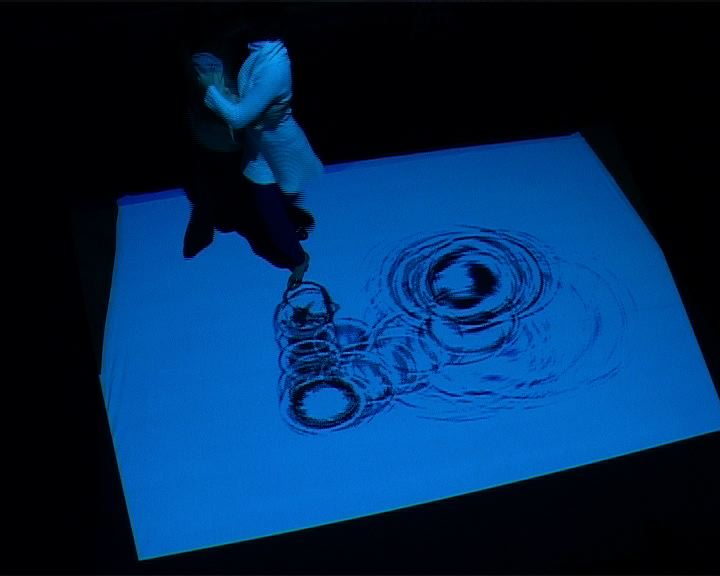
A short film documenting the process of making the film of interactive tango dancing. It talks about some of the technical problems we encountered and shows the interaction of all the people collaborating on the project and how we overcame difficulties together.

More Comments

Comments from a tango friend of mine…

There’s so much scope for expressing the movement and quality of the dance in sound in texture in shape in colour; a kind of synaesthesic tango.

All the dynamics of the movements; the sharp clear lines and spirals, soft sweeps and deep beats lend themselves to being portrayed in other complimentary forms

The visual is only one aspect of the dance

I love this concept it’s so playful, like tapping into a your own sensory experience and projecting into an interactive reality.

Sophie

Comments on the video forwarded from G&S

Solange and Gonzalo sent links to the iTango video to their mailing list, these are some of the responses…

(to Fran,)

All of them don´t say more than congratulation. I ask them a deep opinion of waht they would like to see or do with itango, but I didn´t receive an answer yet.
Ciao!

——————————————————————————————–

…”I still have a very good souvenir of your demonstration (and practica), and now I can see it again, it ´s just perfect! ( even if I don´t know wy videos on Utube have to be recorded by unsteady cameras!!! 🙂 )
But how to getmore info about your group and this media project?”…

——————————————————————————————–

Hi Gonzalo and Solange

I enjoyed watching your itango video, and I wondered what the piece is that
you are dancin to. Maybe you can send me the title or mp3 file. You remember,
we met at Veronic’s place.
Regards, Tobias

——————————————————————————————–

———- Forwarded message ———-
From: Alexandre Mota Kanji <amkanji@gmail.com>
Date: Feb 23, 2007 7:38 AM
Subject: Re: I would like you to see my Tango videos
To: Gonzalo Orihuela <elexperimental@gmail.com>

Dear Gonzalo y Solange,

Thanks for sending me your videos! I really enjoyed them. Your work is very nice. I especially liked the interactive dance floor! Full of possibilities, isn’t it?

Alexandre

Hi Gonzalo & Solange,

Thanks a lot for the great link! I especially like the ‘interactive tango’!

Hope to see you again somewhere sometime – I liked the practica at Veros place a
lot!

Cheers,
Nina

——————————————————————————————–

Hola Gonzalo,

….que bueno… los acabo de encontrar…..

No encontraba “tango la b” por ninugún lado…..hasta que busque con grupos….el que busca encuentra…je je je!!!!.

Felicitaciones por vuestro trabajo de itango, es el de england no..?. Nos gusto mucho y es muy inspirador….aguante la B….!!!