I’ve just got back from a trip to Austria to meet up and rehearse with Gonzalo and Solange, the dancers involved in the itango project. I’d made some changes to the program for the interactive dance floor, and we were trying to work out what it/I was capable of doing with the light effects so that they/we could come up with some choreography to exploit it.
Since the last time we used the program, I’ve added the possibility of changing the colours and the patterns. The colour change is nice, the new patterns don’t show the interactivity so well, so I’m not sure whether to keep them.
We thought about the possibility of catching the pools of light in their hands, and then dropping it. It could be coordinated with me so that when they ‘drop’ the small pool of light, I would wack up the damping and the ripples would spread immediately over the entire floor.
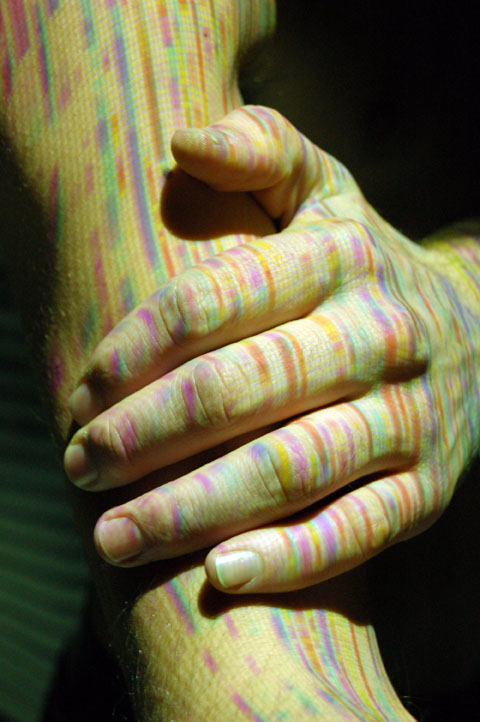
The light looks particularly good on skin, but we’re not sure whether they could perform to the tango audience revealing so much flesh, it’s not usual. Male tango dancers almost always perform in a suit jacket, we’re not sure the tango world is ready for such exposure!
Its spacious, but keeps your foot tapping. Quite eclectic, with the unusual vocal, like a mosque chant or something (sorry, I’m sure there is a better term!) mixed with what sounds like a sampled tango voice. I think the drum beat works well, it’s not always there and it’s not too dominant but it definitely makes the music sound contemporary. I even like the scratchy sound that’s added as another layer, like the crackle of an old record player.
I love this song… ‘Nostalgias’ by Juan Carlos Cobian to the poem by Enrique Cadicamo. I don’t think anyone has made a contemporary arrangement of it yet. I think it might be quite suitable for my itango project because it has a kind of circular melody at the beginning, and in the climax there’s a dramatic repetition of a musical phrase which could work nicely with the ripples. I can imagine really stretching it out at the beginning, being very playful with the speed, and swapping the melody between the instruments.
Another favourite of mine is Piazzolla’s Miolonga en Re.
I love how spacious it is, so minimal with the notes and having only two voices, like his and hers. I like the base line, which sounds circular to me too, repeating the same rhythm and sequence of pitch changes. I think perhaps it’s too exquisite to mess around with though, I don’t want to ruin it for myself!
Shaun (course leader) has asked me this question a couple of times, so I’m giving it some thought. There are of course a number of musical elements that come together to make a tango sound like a tango…
Tango almost always sounds intense, dramatic and melancholy, even though it’s not always in a minor key.
Perhaps the most intrinsically tango theme is the notable run or lead in from the fourth beat to the first (tango is always 4/4 unless its a tango vals but that’s another musical genre). This pre-beat, or ‘and’ moment is reflected in the dance by the intention shown by the leader that he is about to step before he actually does. It gives the music a characteristic ‘vaaarumph’ sort of sound that drives you to move, with a purposeful step. For the guys its a sort of suspension and surge, for the women a sort of resist and submit. This emphasis on the 4-1 is very evident in the music of Osvaldo Pugliese, you will hear it if you listen particularly to the piano in this rendition of ‘la yumba’…
Typically the orquestas of Carlos Di Sarli and Anibal Troilo have quite a slow very rhythmical tempo, often emphasising the 1 and the 3 beats making for a more formal, regular structure to the overall sound, almost like a slow 2/4 (march) rather than a 4/4 rhythm. I could only find one video from Troilo, which isn’t a perfect example, but you can hear in this video, that the 1 and 3 are emphasised, in addition to the ‘and’ 1 moment…
For many people, Angel D’agostino and Vargas made some of the best tango for dancers, because they left space in the music for the dancer to fill and add their interpretation to shape the music. Piazzolla and Pugliese are sometimes accused of being too driving, not leaving any room for the dancers to be a part of the orchestra. Their music is great for listening to but you couldn’t dance a whole evening to their music, it’s almost too demanding.
One of my favourite contemporary groups are the bajofondo tango club, although they don’t claim to make tango music…
“we don’t like the label of “electronica tango”, because we don’t consider what we do to be either tango nor electronica. We believe we do music of the Rio de la Plata, and if you want to create a music that represents today’s sound of places like Buenos Aires and Montevideo –at least in our view-, obviously genres such as tango, murga, milonga and candombe are going to be present, because they are part of the genetic-musical map of that part of the world. But the 40 years history of Argentine and Uruguayan rock, hip hop and electronica also are part of that map and the history of that place”.
It’s fun to dance to their music, I do really like it, but it’s obviously not intended expressly for this purpose. In fact if you watch the video you’ll see that no-one is dancing tango at their concert, they’re just jumping around. The tracks last much longer than a typical tango, which is usually about 3 minutes. Longer than this is difficult to keep going, you start to feel you need a change, or you want to hear the finale, or just stop for a minute. There are also certain tango dancing etiquettes that are difficult to follow when the music drifts too far from the norm. for example the number of songs you dance with one partner before thanking them and sitting down again. This drifting away from writing tango music to dance to really began with Astor Piazzolla, another of my favourite tango musicians. His signatures are really compelling, moving melodies, and the frequent use of 3-3-2 (or 1xx-1xx-1x) rhythms. You can hear this very clearly in ‘libertango’…
The Orquesta de Juan D’arienso is typified by quite a fast tempo. In this superb film you can see how the rhythm is kept by the piano, but then when the piano gets to do a fancy bit the rhythm is taken on by the strings and the bandoneons, the melody and the beat gets swapped around between the different sections, and all the while you can hear D’arienzo driving the orquesta to really emphasise the lead in to the first beat of the first bar of a phrase.
So, characteristic tango elements are…
The ‘and’ moment,
A Melancholy, dramatic feel,
Multiple rhythmic lines,
Multiple melody lines,
Trading melodic or rhythmic elements from one instrument to another.
Use of tango instruments; typically bandoneon, violin, double base, piano, but also flute, guitar and more recently base guitar. Percussion is not used in traditional tango but contemporary tango often has quite prominent beats and bass lines.
I have the films of the last couple of times we made a performance using the itango pogram, so I’m thinking I will start with those.
I have to imagine the sounds that go with the images in the film…
For the projected images, I think the big rich ripples (where I’ve set the damping to let the ripples live a long time) should be a low humming slowly pulsing warm sound…. Vhoommvhoommvhoom…maybe from the bandoneon or an electric base guitar.
Then, when the ripples are small and following quickly behind the dancers it would be more tinkling cool sounds…. Tingtingtingtingtinklenklenlkenlkenkle… fading to nothing. Water dripping onto something metallic, or little wind chimes…
Another layer, I want to make some electronic sounds to mix with the real instruments…
Maybe could pour water over some circuit board that might make fizzing electronic noises, like Phil’s circuit bending. I’ll have to play around and record it, then sample a good bit.
Then there could be an instrument for each of the dancers, a male and a female. Bandoneon or base guitar for the man and flute or violin for the woman?
Sometimes the ripples pulse, when I change the damping and it catches up with itself. This could be mirrored with repetitive sounds, a manual echo, each repetition of the phrase getting quieter.
I’m thinking about creating some music to use with the interactive tango performance. I like the piece we used in the performance at Tango-del-Bosque, particularly the way the music comes in on the first note and you’re not sure whether it’s feedback or a note… it gradually becomes apparent. I’d like to keep this electronic sound because I think it’s appropriate for the cyclical element of the visuals which come from a feedback loop.
I don’t think I’m capable of composing anything just yet, so I think I will attempt to write and record an arrangement of a traditional tango but try to give it a contemporary sound, perhaps adding a beat but trying not to lose the elements of a tango that make it so enjoyable to dance to for me… in comparison to dance music now. Tangos have many different layers to them, the rhythm is one layer and provides the structure but it never dominates the music, the dance is inspired by the melody lines of which there are often several. The beauty of having so many different elements to the music is that you can choose and illustrate with your steps whichever line of the music you are listening to. This is one of the things I was trying to show with the Milonga Feet video.
At the Tango Del Bosque festival at Bylaugh Hall in Norfolk, Gonzalo, Solange, John and I set up the itango performance for the festival. This is the film of the live performance, just one take edited from the footage of the tracking camera and John’s camera on the ground.


 Fran's Blog