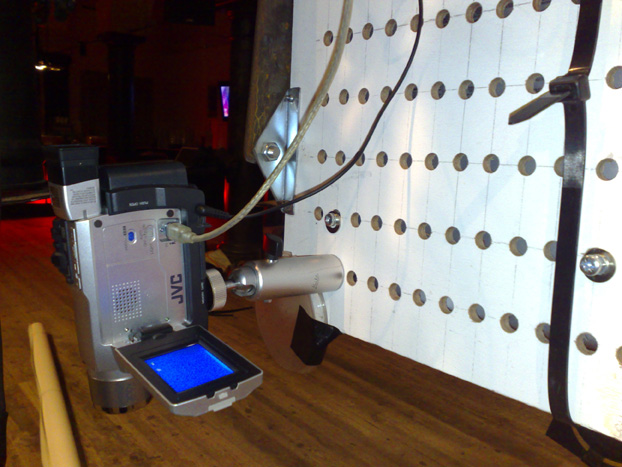
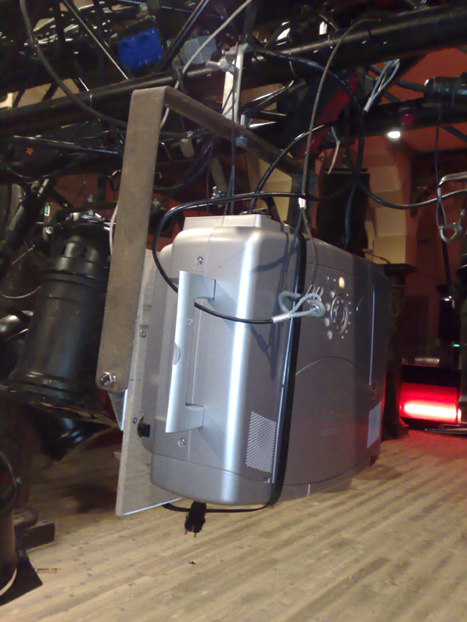
One of the obstacles I was aware would have to be overcome, was that the performance space was the dance floor on which a hundred or more people would be dancing for several hours before the performance began. I had been worrying for some time about the logistics of this. How I would be able to turn on the camera and the projector on the rig without being able to reach them. I didn’t have a remote control for my camera and the projector was to be provided on site. Luckily, I was able to borrow a video camera which would stay on as long as there was no tape running in it (mine would always switch itself off), and the projector had a remote so it looked like everything was going to work. We tested it out in rehearsal, and everything worked perfectly, the tracking I had set up in the morning was still working perfectly in the afternoon when we came back to it. But… just before the performance began, Koen, the local technician, sound and lighting designer, asked me to let the projector warm up on a black screen when I turned the projector on before the performance began. This meant I had to fiddle with the second monitor’s display to get a black screen saver. In changing this, the display size changed, which I didn’t realise until we came to begin the performance. When I came back to the laptop as the dance floor was cleared and the white lino floor rolled out, the projector saw nothing! The screen to be projected was the wrong size, and for some reason, no matter what I did, it would not update the screen arrangements while MaxMSP was running. The only thing I could do to rectify the situation was restart MaxMSP, and in the process I lost all the tracking settings and the starting patterns for the performance that we had spent all morning tweaking. Disaster! I had to guess at where everything was when we left it, but it wasn’t what the dancers (who knew nothing about the technical hitch) were expecting to see – which they later told me completely threw them. They had no idea whether anything we had planned was going to happen and they lost confidence in the whole performance.
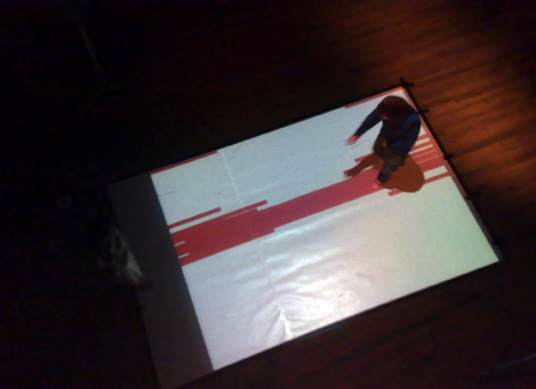
To add to the problems, the lights were too high in the auditorium (much higher than we had agreed on in rehearsal), despite Gonzalo’s request before they began that they be lowered. The shadows couldn’t be seen properly because the extra lights were casting shadows in all directions and there were no strong blacks directly beneath them. The extra light rendered the paler projected colours almost invisible, so I had to use darker colours in the patterns in order for them to be seen, which then confused the tracking further, and the dancers felt a keen loss of control over the outcome. It was all quite disastrous as far as we (the dancers and I) were concerned. It was a pretty light show in the end, and not much more. We were all left feeling quite flat. The interactivity was not clear at all, the audience I think on the whole were left wondering what it was all about, even thinking that the dancers were following a predetermined pattern of lights which misses the point completely.
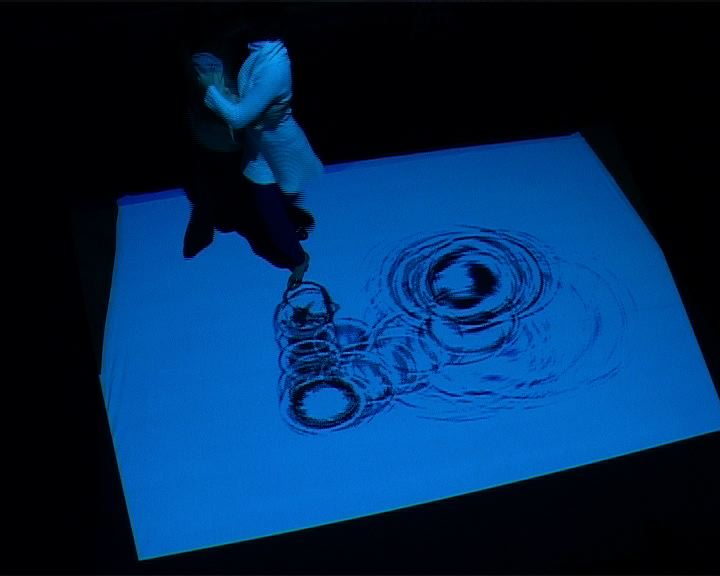
There was one negative thing that actually was positive to me… In the third song, the dancers danced a choreography they usually do without the program. Although I didn’t think it looked very good, it was some consolation to me because it was very obvious that they were dancing without regard to the pattern they were creating. I was pleased to note the contrast in the way they danced when they were thinking about working with the program and the way the danced without. It was absolutely clear that when they were interacting with the patterns it altered their steps, and so achieved my goal of an interaction between the physical and virtual worlds. The dance floor became an interface that engaged with whole bodies, a far more immersive experience and a more natural interaction than merely that of hand to keyboard or mouse.






 Fran's Blog