What to do with the data

I’d like to try getting my existing tracking system to control a flash file.

I found this site recently, when I was looking around at flash sites for inspiration in the last project.

http://www.screenvader.com/root.html
screenvader

I love it!

First off I love the movement of the animation in the initial navigation. I think this would work so well in my environment if I could figure out how they did it. I don’t want text, but if I could make a pattern move in this way, it would be like the floor coming up to meet every step I took, and falling away on all sides. This is something I like to feel – and I don’t think its an idea unique to tango, martial arts and yoga have this feeling of connection with the ground. drawing energy from it, moving it through your body and out into the world.
random image generator random image generator 2random image generator 3random image generator 4

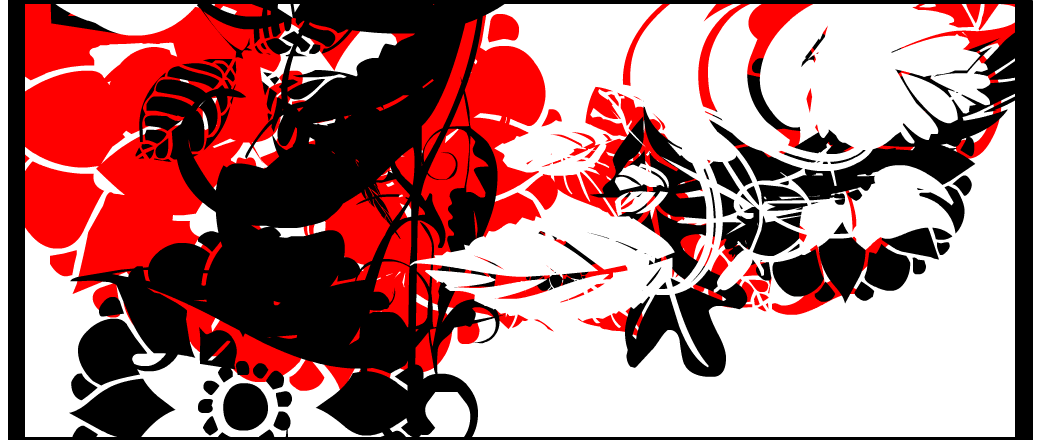
Another thing I love on this site is the random image generator. Above are four images that were generated randomly on four consecutive clicks. Its like what I was thinking about with regard to a tuning of a space. setting up parameters and rules so that however the elements are thrown together inside it, they will work. Designing a template, a structure that will allow random elements to play and interact within it, always creating something beautiful.

I must admit, when I went to the site just now to take some snapshots of the screen, I started to become selective. I didn’t take the first images generated because I wanted a good one, one I felt looked ‘designed’ . This is what Eno Henze was talking about at the lecture on Generative art I went to in Berlin last month (‘generator-x‘). The altered role of a generative artist… not so much the creator as the curator. He writes the programs that generate the art, but doesn’t directly make it. His artistic role is in selecting the images that he exhibits. Not dissimilar to the role of a photographer or editor I suppose.

New ways of tracking movement

I’ve been thinking about new ways to gather data from the dancing bodies. The movement I want to use to trigger an animation is the ‘boleo’. It’s the movement that results from a sudden change of direction in the energy of the lead. This can be back to forward horizontally, which sends the follower’s free leg straight back and up – it feels and looks like a whip, if you can visualize the motion of a hand cracking a whip, this is what the dancers do with their whole bodies, the leader is the hand, the followers body the handle and her leg the tip of the whip. If the reversal of energy is circular, from clockwise to anti-clockwise, the movement of the leg is also circular, the toe draws a loop in the air. These are the patterns that can be seen in the photos I posted last week.

Anyway, I digress. The point I was going to make was that I have been trying to find a way to capture this movement digitally. Way back when I was first thinking about the project, it was suggested that a colour on the sole of the followers foot could be picked up by my camera and colour tracking device, but it was nowhere near sensitive enough to be able to do that. I thought about a microphone on the shoe, which would be ok for footsteps, but not the movement I want to capture as it is silent. Recently I’ve been investigating accelerometers. I found (or rather somebody told me about!) these sites…
The need for the “CUI” (In the Media Arts and Technology program, we explore new metaphors for artistic interactivity that connect the physical world with the virtual realm.)

and this one…
Contextual Computing Group: Bluetooth Accelerometer

http://www-static.cc.gatech.ed… (This is a small wireless sensor platform providing a bluetooth SPP link to three axes of accelerometer data. The accelerometers are sampled by a PIC microcontroller (onboard ADC) at roughly 100Hz (rate can be changed via firmware)…)

Web Elective

Just to keep it all together, this is a link to my new website, a site I created to submit as work for the elective unit…

thevirtualgarden.co.uk

Nothing to do with tango for a change!

The brief I gave myself was to design and build a web site to sell my pattern designs and at the same time showcase my skills as a flash content and website designer and illustrator.

I wanted the three gardens to be based on the patterns I had previously designed, but to also have quite distinct feels to them. Like a real garden might have different rooms, I wanted each page of the virtual garden to give you a sense of wandering through a changing environment. I tried to achieve this by giving each garden it’s own colour palette and slightly varying the illustrative style to be in keeping with the theme. For example, the Japanese garden uses brush strokes in the pattern evoking a Japanese style of painting, it also uses a traditional Japanese pattern to indicate the movement in the water. The colours are cool and clean. The only element that is out of style is the lily pad, which uses rich warm greens and browns, a palette more in keeping with the tropical garden, the garden that you will find if you interact with the lily pad… It’s supposed to be a small clue that it is the doorway into the next garden.

inspiration for patterns

dsc_1140.jpgdsc_1100.jpgdsc_1122.jpgdsc_1123.jpgdsc_1131.jpgdsc_1136.jpgdsc_1149.jpgdsc_1134.jpgdsc_1132.jpg

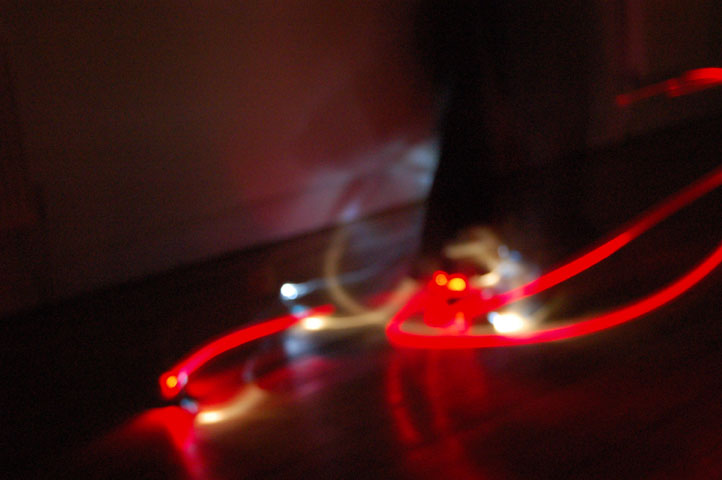
I was looking at some rhythmnic gymnastics videos on youtube the other day (some are posted on my dance film page), and it got me thinking about the motion path of my feet, I thought about trying to get hold of a ribbon and attaching it to my feet to see if it would produce any results as beautiful as the gymnasts… but it seemed unlikely, with two people dancing it would just get tangled up. Instead, I attatched lights to my feet and put my camera on a tripod set to a slow shutter speed… I was quite pleased with the pictures, but I’m not sure yet how the patterns can be incorporated into my project. Perhaps it will be possible to mathematically recreate some of the parabolic shapes for projection.

Altered states and film

Except from ‘Deleuze, Altered states and film’ By Anna Powell

‘For Guattari, aesthetics are viral in nature, being known ‘not through representation, but through affective contamination’. In its broader, verbal usage, to affect is to ‘lay hold of, impress, or act upon (in mind or feelings)’ or to ‘influence, move, touch’. Affection as noun is ‘a mental state brought about by any influence; an emotion or feeling’. Although it retains connection to more general meanings, Guattari uses affect in a special sense here and in his work with Deleuze. Affect also permeates Deleuze’s solo-authored cinema books, with both the movement-image and the time-image as distinct but congruent explorations of it.
Henri Bergson is the main philosophical precursor of Deleuze’s temporally based cinematic affect. Bergson accused early cinema of representing the flux of matter in time as a series of static ‘snapshots’ that, strung together by mechanical movement, prevent awareness of duration.
Despite this explicit distrust of the ‘cinematograph’, Deleuze identifies a fundamentally ‘cinematic’ philosophy in Bergson’s implication of ‘the universe as cinema in itself , a metacinema’. Both regard the world as ‘flowing matter’, a material flux of images and the human perceiver as a ‘centre of indetermination’ able to reflect intensively on affect.
For Bergson, perception is extensive and actual but affection is unextended and virtual. Unlike perception, which seeks to identify and quantify external stimuli, affection is qualitative, acting by the intensive vibration of a motor tendency on a sensible nerve. Rather than being ‘geographically’ located, affect surges in the centre of indetermination. Its pre-subjective processes engage a kind of auto-contemplation that participates in the wider flux of forces moving in duration.’

Thinking about cyborg consciousness

The following are some excerpts from ‘The Cybercultures Reader’
By David Bell, Barbara M. Kennedy
(p286) As Haraway writes ‘late twentieth century machines have made thoroughly ambiguous the difference between natural and artificial, mind and body, self-developing and externally designed.’

(p289) Starting from Haraway’s initiatives, Sandoval suggests that ‘cyborg consciousness can be understood as the technological embodiment of a particular and specific form of oppositional consciousness’. This cyborg consciousness needs to develop out of a set of technologies that together comprise and formulate a ‘methodology of the oppressed’ – or what she refers to as a ‘mestiza’ consciousness. Sandoval recognises five specific ‘technologies of energy’. First is semiotics, the ‘science of cultural signs’. Second is the process of challenging dominant ideological signs through deconstruction. Third, she suggests, is ‘meta-ideology’ – an operation of appropriating dominant ideological forms but then utilizing them in order to transform and transpose meaning structures. Fourth is the technology of ‘democratics’, collecting together the previous three areas to bring about a social egalitarian relational, with a new exploration of the concept of ‘love’ within post-modern discourse. Finally she suggests ‘differential movement’ – the one through which all the others manoeuvre, flow, energize, in polymorphous ways.

… indeed, Sandoval uses Deluzian terms like ‘rhizomatic’ to describe the vectors, webs and velocities of differential consciousness: ‘Differential consciousness can be thought thus as a constant reapportionment of space, boundaries, of horizontal and vertical realignments of oppositional powers. These energies revolve around each other, aligning and realigning in a field of force.’

James Turrell

I can’t beleive I’ve been working with this light projection project for a year and not mentioned James Turrell (an artist who works exclusively with light and atmosphere) in the blog once…

I first became aware of his work in my teens, when I went to his exhibition somewhere in London. It was a square room without ceiling, so that the sky was framed by the walls. As dusk came on, the walls were invisibly lit by a soft orange light that made the deepening blue of the sky resonate. It was quite a profound, meditative experience. I think this must be it… http://www.henryart.org/skyspace.htm, but it’s not quite as I remember it, not sure if that’s my memory or if the piece changed.

Some links to articles on other works by James Turrell: http://www.geocities.com/jvansant_2000/zturrell.htm

http://www.preview-art.com/features/turrell.html

Story telling in music… Ravel’s Ondine

I went to a piano recital at the John Innes centre last night, Milan Miladinovic was playing a varied program, including Bach, Ravel, Chopin & Liszt. He was quite an astonishing pianist, I was captivated! Huge dynamic variation and accuracy in some incredibly technically difficult pieces. In addition to the musical drama, he gave some wonderful introductions to the pieces, almost a master class in interpreting musical elements and compositional components. Sometimes playing sections of a piece to demonstrate a representation of part of a story, but also talking about the composer’s life and the events and thinking of the time, he shifted our attention back and forth between the work’s contextual aspects and its musical components, allowing the two aspects to comment mutually on each other and inform our interpretation of it’s meaning. It was fascinating!

The longest introduction he gave was probably for Ravel’s ‘Gaspard de la nuit’. The pieces are an interpretation of the dark poems of Aloysious Bertand. One of the Poems Ravel was interpreting is entitled ‘Ondine’, from the book ‘La nuit et ses prestiges’ – ‘the night and it’s illusions/deceptions’. The original fairy tale of Ondine (the inspiration for Disney’s ‘little mermaid’), is about the attempted seduction of a mortal by a mermaid, which does not relate particularly to the night, but Bertrand’s poems apparently concentrate on the not clearly lit, the dreamlike and the surreal. The music is undeniably watery, with shimmering trills that could be heard as the lights on the waves or the otherworldly tears and laughter of the mermaid.

This morning, inspired by the recital and the story telling, I found a copy of the poem that the work is based on, and a version of the piano piece so that I could read and listen to them together, and try to hear how the story and the music fit together. You can do the same if you like…

I don’t speak French, but if you do, you can read the original in French here

‘Listen! listen! it’s me, it’s Ondine who brushes with these drops of water the resonant diamonds of your window lit by the gloomy moon-light; and there in her silken robe is the lady of the manor contemplating from her balcony the lovely star-bright night and the beautiful sleeping lake.’

‘each ripple is a child of the waves’ swimming with the current, each current is a path winding towards my palace, and my palace is built fluid, at the bottom of the lake, in the triangle of fire earth and air.’

‘Listne! -Listen! – my father strikes the croaking water with a branch of green alder, and my sisters caress with their arms of foam the cool islands of herbs, water lillies and gladioli, or make fun of their sickly, bearded willow that is fishing with rod and line.’

Having murmured her song, she begged me to accept her ring on my finger, so that I would be the husband of an Ondine, and to visit her palace with her, so that I would be king of the lakes. And since I replied that I loved a mortal woman, she wept a few tears, sulking and peevish, then broke into laughter, and vanished in showers of rain that drizzled white across my blue window pain.

I found an excellent essay looking at this particular work, deconstructing the music and the poem in depth here by Siglind Bruhn.